
In Ireland Mayday is surrounded by a rich folklore tradition, most of which dates from 19th century. These beliefs give an insight into the mindset of a earlier, more rural Ireland where the spirit world and superstition still prevailed. While archaeologists are mainly concerned with the physical remains of past cultures, folklore can help us understanding how some of these people thought and why they carried out the actions they did.
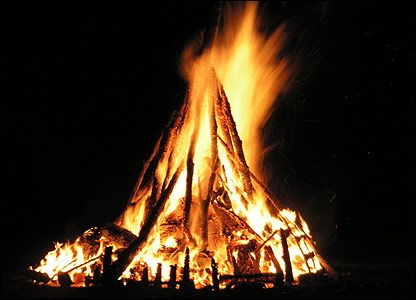
Mayday corresponds with the Irish festival of La Bealtaine, which officially heralded the beginning of the summer. Its name appears to derive from the Old Irish words Bel taine meaning ‘bright fire’ and it was surrounded by a large number of folk beliefs some of which had possible pagan origins. As the name of the festival suggests bonfires played an important part in the activities and were often lit on prominent local landmarks with the Hill of Uisneach in Co. Westmeath being the most famous example.
A particularly common tradition involved driving herds of cows between two bonfires in the belief that this would purify the herd and also bring luck. It was also deemed unlucky to give away salt, fire or water on Mayday as the luck and profits of a farm went with these gifts. Witches and the fairies were also believed to be unusually active during this period and a number of actions could be taken to protect your home and especially your livestock. Milk could be poured across the threshold of the house or byre to prevent entry by the ‘wee folk’ or more gruesomely the cattle could be driven to the nearest ringfort or “fairyfort” and some of their blood spilt on the ground to appease the spirits. Ringforts are the classic early medieval settlement type and were long abandoned by the 19thand 20th centuries when they had become associated with the fairy folk.
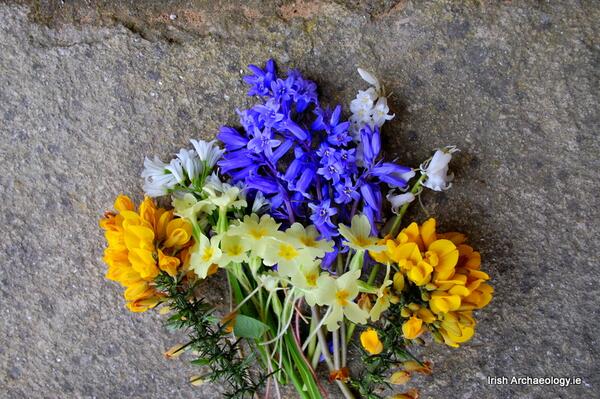
May flowers, such as primrose, gorse or hawthorn blossoms, were gathered before dawn and placed in bundles on door posts to ward off evil. Similarly sprigs of rowan or hawthorn could be placed over the byre door or even across the horns of the cows to prevent ‘milk thieves’, the prevalent belief being that someone could steal your summer’s milk supplies through the incantation of specific curses.
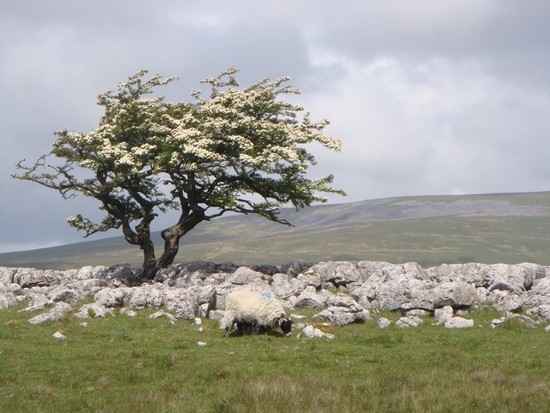
‘May bushes’were also erected in farm yards and around villages. These normally consisted of hawthorn branches that had been driven into the ground and then decorated with rags and other items. The following account from the 1930’s details the erection of a May bush in Taghmon, Co. Wexford.
‘It is a custom in the Taghmon district to hold celebrations on the first day of May with a May bush. A number of boys go out in the country armed with a saw or hatched. They cut a blackthorn bush or sceach. They then get an old bucket and fill it with clay. They stick the bush down in it and take it to a waste bit of land in the neighbour-hood of the village. Then they start to decorate the bush with coloured papers, candles, painted eggshells and pictures. Then they select a king and queen. The king and queen take it up and march around the streets with it. The people give them pennies. Then in the end they burn the May bush and spend their money. This custom has been carried on in Taghmon as long as the oldest resident can remember‘
Some traditions also surrounded human fertility, such as the creation of May babies. In this curious custom a figure of a female (the May baby) was placed on a pole and then covered in flowers, ribbons and straw. A man and a woman, also dressed up in costume, would then dance around the figure and make vulgar displays to the on watching crowd. It was believed that attending this spectacle would help people trying to conceive.
Links/References

wonderful life giving shots…thank you
Thanks Maria 🙂
I came across a piece by Willie Wilde (father of Oscar), many moons ago so I can’t remember it precisely, who recorded a blood-letting ritual in Roscommon during the 19th century. It was associated with some large enclosures in the Rathcrogan complex. Is this the same source you are using for your piece or another one?
Hi Ickle,
I got it from E. Estyn Evans ‘Irish Folk Ways’. It’s on page 272. Here is a link to the book http://books.google.ie/books?id=HjDPRIC6QhwC&printsec=frontcover&dq=irish+folk+ways&hl=en&sa=X&ei=b2WhT6jcCYbJhAfLmaydCA&ved=0CDMQ6AEwAA#v=onepage&q=irish%20folk%20ways&f=false
Hope this helps,
Colm
i am from the woods and oarks family one quarter irish and would like to know more!!
It’s worth noting that before the Julian calendar was introduced, the date was most likely a phase of the moon closest to the cross-quarter day midway between the spring equinox and summer solstice. I believe this year that cross-quarter day would fall on the 5th. Though I don’t now remember the source, some years ago I came across a description from the 19th century in the Hebrides, where they wove daisies into the tails of the cows and drove them between the fires off to the summer pastures “singing hymns to the golden-haired virgin Mary.”
Thanks for sharing that Ronald 🙂
That was probably in the Carmina Gadelica, a 19th century folklore collection by Alexander Carmichael. It’s available to read on line.
Taken from Munya Andrews book: http://www.amazon.com/gp/aw/d/1876756454/ref=redir_mdp_mobile
“The origins of Halloween lie in the old Celtic feast of Samhain, or All Hallows’ Eve, that was later Christianised as All Saints’ Day. While it is commonly understood these festivals celebrate the dead, it is a lesser known fact that they ultimately derive from ancient beliefs and observations of the Pleiades. At midnight, on or about the first of November, these stars reach their highest point in the night skies of the Northern Hemisphere. Prayers for the dead were recited at midnight, for people believed the spirits of the dead would rise from their resting places on this precise date and time to visit family and friends to make merry and feast. Hence the tradition of “trick-or-treat customs descended from a belief that the family dead would bring gifts or goodies to the children during their temporary return from the other world. The original Celtic Feast of the Dead was actually a three-day festival regulated by the cluster and not three separate, unrelated feast days, says William Tyler Olcott in STARLORE OF ALL AGES. A common pagan custom at the feasts of the dead was to extinguish “every fire in the land”, say the Jobes. This was done to ensure that the ghosts of the dead could travel to their to their final resting place in the Far West. However, once the stars of the Pleiades ‘passed the meridian, the Druids lit new fires which were carried by fast runners the length and breadth of the land, and in this way each village started its own sacred flame’. The fires of Beltane and other celebrations involving the cluster, such as the annual May Day festival and its famous dances around the maypole, a thinly disguised Tree of Life and an ancient symbol for the cosmic axis. The spring festival celebrating life in the Northern Hemisphere ‘when the Pleiades rose on the first day of May’ after the long , cold winter was celebrated by the fires of Beltane that give rise to such traditions as lighting bonfires and dancing around the maypole. Occurring ‘exactly midway through the year,’ the lighting of the fires symbolised the death of winter and the “rebirth” or the approach of warmer weather, when the stars of the Pleiades ‘rose at dawn’. More popularly known as Mayday, ‘the festival was named after the Celtic Fire God, Bel.”
From where I come from in Ireland the month of May ( or in Irish Bealtaine) is pronounced B-YOWL-TINNA, not Bel Taine
Thank you for giving a much warmer pronunciation.
We still practice this tradition every year here, in the breton speaking area of Morbihan/Bro-Gwened, Brittany. We do place.
THE MAY BRANCH
LE RAMEAU DE MAI
Barroù Mae
If you have ever been in the area around Vannes on the first of May, you will have seen the countryside decorated to celebrate the start of the new season.
From the banks of the Lac de Guerlédan to the gates of the city of Vannes itself, houses, farm buildings, gardens, fields, and even beehives are adorned with the May Branch.
This tradition is particularly alive such places as Kerfourn, Locminé, Baud, Bubry, St Jean Brevelay, Grandchamp and Belz but it can also be seen in Langoëlan, Perret and Lescouët-Gouarec. In fact it has survived in most the Breton-speaking communities in the Vannes region (Morbihan) – down to the coast, and even onto some of the islands.
The custom does not seem to have ever spread eastwards into the Gallo-speaking areas and it is not clear to what extent it was ever practised further to the west, into Cornouaille. It would be interesting if readers could provide information about where they see it practiced.
Anyway, in the evening of April 30th, before sunset, people make a point of hanging a beech branch, or, less commonly, a birch branch*, by their front door or on their shutters, or to plant it somewhere on their land. Everyone has somewhere where they can hang a ‘May Branch’, and in some places, such as Silfiac and Grandchamp, part of the tradition is for an old man or woman to make a tour of village to inspect the May Branches.
(*) On the coast and on the islands, where it doesn’t grow, beech is replaced by a branch of flowering white hawthorn.
THE MAY BRANCH (following)
When people are asked about the origins of the May Branch, the usual response is that it is ‘traditional’, with no further explanation being provided. Sometimes however, more detailed reasons are given: “To celebrate the return of warm weather”; “Because May is the month of Mary”; “To bring happiness”; “To protect the homes or crops from lightning”; “To ward off ghosts and evil spirits “; “To keep off bad luck”; or “To protect against witches”…
Some people fix the May Branch to their post box to keep off bad news, others put on their car to prevent accidents and beekeepers often place a branch on their beehives. Farmers believe that the tradition helps to protect livestock from disease and to prevent the drying up of springs and water wells.
Often, people say that the Branch of May “prevents toads from entering the house”, which is not very polite to these harmless amphibians which are so useful in the garden.
It is possible, however, that it is a tradition derived from the druidic festival of “Beltane”, dating back to pre-Roman times. In Celtic mythology Beltane is the most important celebration of the year after “Samhain” (Halloween). Indeed, the Celtic calendar had only two seasons, and May 1 was the first day of summer – the first day of the ‘season of brightness’ that would run until the Samhain (November 1st), the first day of the ‘season of darkness’.
The “Branch of May”, beech, birch or hawthorn could be a symbol of renewal, fertility, love. Its current use might suggest that it is also a means of purification and protection, according to Celtic symbolism.
MIKEL LE BILLAN
On May 1, my grandmother and her seven sisters rose before dawn and, without speaking a word, went outdoors. The youngest would fall asleep on the way down the stairs, so they took along an alarm clock to wake her, since it was essential that no one say a word.
Then they washed their faces in the morning dew.
I’m fairly sure this was so they would be beautiful (and they were!) but I wonder if there was lore about finding a husband that I just don’t remember.
All this was happening in America, in a small city, where enough dew may have been hard to find.
Does anyone know of this custom In Ireland?
Yes it was still taking place my mother and her mother would wash there faces in the early morning due on the 1st of May in rural Leitrim circa 1940s. Also placing flowers outside the front door which my mother still does to this day.
Hi.was just reminding myself of some of my parents customs. I always wash my face and walk barefoot in the May morning dew. My mother who is in her 80s says all women and girls used to do so. It is meant to give one eternal youth and aid in the search for a husband.
It was a tradition in many parts of rural Scotland up to the 1930s.
Its still celebrated in Arklow, co wicklow. Be great if it was like the Edinburgh Fire Festival.
Our May Bough was decked with ribbons by the younger boys & girls this Mays Eve before they went off Garlanding -leaving posies on the steps of neighbours especially those who are older or not in the best of health.
I love learning about Irish folklore and traditions. I find most are magical. I often feel like introducing some of them to my own household. To bring them back to this modern world. Or keep them alive.
In the Rhineland in Germany, Maibäume (literally May trees but frequently branches, usually birch) are decorated with coloured streamers by the youths and young men and placed at the door of their girlfriends or a girl they are interested in. They are left there for the whole month of May. On the night of 30th April, the young men get together and go from house to house, considerably fuelled by beer, setting up the trees. At the end of the month, the trees are collected again. This time the beer is supplied by the girls’ fathers. In some places a May king and queen are selected, in others there is also a village May tree. In some districts, the tree is guared by the young men to prevent it being stolen or damaged by their counterparts from another village. Another custom is Maiansingen or singing in the May. Choirs sing traditional May and early Summer songs. This is often on30 April and accompanies the inauguration of the village May tree.